Foresight methods are typically classified according to the stages and modes of conducting research.
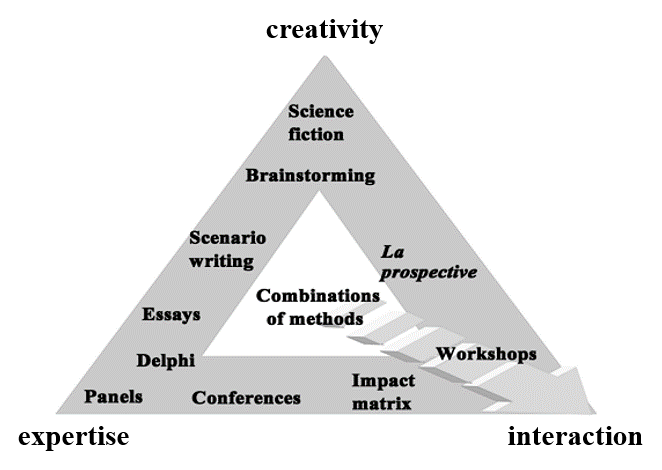
The key stages of expert communication—creativity, expert knowledge, and interaction—are located at the vertices of the triangle. The positioning of foresight methods within the triangle reflects their ‘attraction’ to a particular corner.
According to Ben Martin*, three stages were identified when analysing the procedural aspects of this approach.
- Preparatory stage: selection of foresight goals and methods.
- Research stage: achievement of the project’s final outcome (forecast, scenarios of development, roadmap, analytical report, etc).
- Social engagement stage: discussion and validation of foresight results, and preparation of strategies to support or develop the studied subject.
A second attempt to classify the significantly increased number of methods was made in 2008 by futurist Rafael Popper**.
As a result, a new figure emerged—the ‘Foresight Diamond.’

The principles of foresight methodology are presented as a diamond whose corners reflect ways of generating new knowledge:
- creativity
- interaction
- evidence-based validation
- expert assessment
A project's goals and objectives determine the choice of methods close to the various vertices of the diamond.
For example, qualitative methods are located primarily in the upper part, quantitative methods in the lower one, mixed methods in the middle, and so on. When implementing a project, it is necessary to use a set of methods within the foresight diamond that reflects all four ways of generating new knowledge.
The classification of methods is based on two criteria: method of analysis (qualitative, quantitative, and mixed methods) and data source (creativity, experience, interaction, and quantitative data).
Qualitative methods rely on expert knowledge.
Quantitative methods are based on the collection and analysis of numerical data using mathematical, statistical, and logical tools.
Mixed methods combine quantitative and qualitative approaches, compensating for the limitations of both and providing a deeper, more comprehensive understanding of complex phenomena.
Methods that leverage the creative potential of experts rely on the inventiveness of their thinking and their insights.
Methods based on the expertise of specialists from various fields are used to formulate recommendations for future planning.
Interaction-based methods are used in foresight studies to ensure the legitimacy of the proposed visions of the future.
Methods based on objective data analysis are effective for evaluating technologies and the effects of their implementation. Typically, they complement quantitative methods, as they enable analysis of documented sources. Big data analytics is becoming an increasingly popular method due to the emergence of numerous tools for rapid, intelligent processing of large datasets.
I. Miles*** and Popper identified five stages of foresight depending on specific nature of the tasks being addressed.

A similar classification, comprising six stages, is proposed by Hines and Bishop****:

The third model of foresight studies was proposed in 2018 by HSE University researcher Ozcan Saritas.
According to Saritas's concept, various sets of foresight methods are employed during the initiation, exploration, imagination, integration, interpretation, intervention, evaluation, interaction, and process management stages of a foresight study.
Since many foresight methods fall into multiple categories, the scholar proposed a classification based on a cluster approach. This approach enables methods to be grouped according to their objectives and research methodologies. The proposed visualisation significantly simplifies the selection of specific methods when designing a foresight study.
*Martin B. (2001). Technology Foresight in rapidly globalizing economy, Vienna.
**Popper R. (2008) Foresight Methodology: an overview and more. IFQ.
***Miles I. (2002) Appraisal of Alternative Methods and Procedures for Producing Regional Foresight. Report prepared by CRIC for the EС – ETAN Expert Group Action. Manchester
****Hines A., Bishop P. (2007) Thinking about the Future. Guidelines for Strategic Foresight
*****Saritas О. (2013) Systemic Foresight Methodology. In book: Science, Technology and Innovation Policy for the Future.